Kategorie:

Irak

Islamisten feiern Fortschritte der irakischen Frauenbewegung

Von 1. Februar 2008 um 13:40 Uhr

Soeben wird gemeldet:

“A female suicide bomber blew herself up at the main pet market in central Baghdad, killing at least 46 people and wounding dozens in the deadliest bombing to strike the capital since 30,000 more American troops began flooding into central Iraq last spring, police said.

About 20 minutes later, a second female suicide bomber struck another bird market in a predominantly Shiite area in southeastern Baghdad. That blast killed at least 18 people and wounded 25, police said.”

Mehr hier.

Die christliche Rechte in USA bröckelt: Reue für den Irakkrieg

Von 29. Oktober 2007 um 18:37 Uhr

Ein aufsehenerregender Bericht der New York Times zeigt, dass die evangelikale christliche Rechte sich zersetzt: Viele evangelikale Christen zeigen Reue dafür, dass man sich so sehr an die Republikanische Partei gehängt hat und dass man den Irakkrieg so gedankenlos unterstützt hat. Manche streben vom rechten Rand des politischen Lebens her wieder in die moderate Mitte. Abtreibung, Schwulenehe und andere Symbolthemen sind angesichts der Krise Amerikas – vor allem verursacht durch das Irakdesaster – nicht mehr so wichtig. Bush verliert seine treuesten Wähler.

Zitat:

Some claim the falloff in support for Bush reflects the unrealistic expectations pumped up by conservative Christian leaders. But no one denies the war is a factor. Christianity Today, the evangelical journal, has even posed the question of whether evangelicals should “repent” for their swift support of invading Iraq.

“Even in evangelical circles, we are tired of the war, tired of the body bags,” the Rev. David Welsh, who took over late last year as senior pastor of Wichita’s large Central Christian Church, told me. “I think it is to the point where they are saying: ‘O.K., we have done as much good as we can. Now let’s just get out of there.’ ”

Welsh, who favors pressed khaki pants and buttoned-up polo shirts, is a staunch conservative, a committed Republican and, personally, a politics junkie. But he told me he was wary of talking too much about politics or public affairs around the church because his congregation was so divided over the war in Iraq.

Welsh said he considered himself among those who still support the president. “I think he is a good man,” Welsh said, slowly. “He has a heart, a spiritual heart.”

But like most of the people I met at Wichita’s evangelical churches, his support for Bush sounded more than a little agonized — closer to sympathy than admiration. “Bush may not have the best people around him,” he added, delicately. “He may not have made the best decisions. He is in a quagmire right now and maybe doesn’t know how to get out. Because to pull out now would say, ‘I was wrong from the very beginning.’ ”

Some were less ambivalent. “We know we want to get rid of Bush,” Linda J. Hogle, a product demonstrator at Sam’s Club, told me when I asked her about the 2008 election at her evangelical church’s Fourth of July picnic.

“I am glad he can’t run again,” agreed her friend, Floyd Willson. Hogle and Willson both voted for President Bush in 2004. Both are furious at the war and are looking to vote for a Democrat next year. “Upwards of a thousand boys that have been needlessly killed, it is all just politics,” Willson said.

Ganze Geschichte hier.

Der Irakkrieg und die Krise des Islam

Von 21. September 2007 um 11:47 Uhr

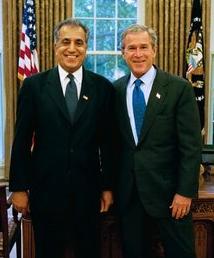
Der Irak-Reporter des New Yorker, George Packer, hat ein grosses Stück über die Pläne und Szenarios für einen amerikanischen Rückzug geschrieben, den man lesen sollte (“Planning for Defeat”). Packer hat auch ein interessantes Blog. Da veröffentlicht er Auszüge aus Gesprächen, die er nicht verwenden konnte – etwa mit Lee Hamilton (vom Baker-Hamilton-Report) und mit Zalmay Khalilzad, dem ehemaligen Afghanistan-Berater der Bush-Regierung und US-Botschafter im Irak, heute UN-Botschafter der Vereinigten Staaten. Khalilzad, der letzte verbliebene Neocon (der allerdings Kreide gefressen hat), sagt ein paar kluge (und beängstigende) Dinge in dem Interview:

And the region is so important for the world now. I compare it to Europe in the first part of the twentieth century, when most of the world’s security problems came from that dysfunctional region, and now we’ve got this region that’s causing all these difficulties.

Dr._Zalmay_Khalilzad.jpg
Würde man heute so auch nicht mehr machen: Khalilzad beim Chef, 2003 Foto: White House

The ultimate beneficiaries of a regional war might be radical Islamists, whom Khalilzad sees as representing a tendency that’s at the heart of Islam itself:

This sort of scenario could strengthen a streak within Islam which is present in its doctrine but is not shared by everybody who is Muslim. In this time, when there is a crisis of Islamic civilization about how to cope in this world and why Muslims are situated the way they are right now, there is a stream which says, “We have to go to a kind of puritanical Islamic rule and fight against the Christians or others until the world is Muslim. There cannot be peace until we have converted everybody to Islam.” That streak exists in the doctrine; if you do a hermeneutical analysis of the texts it is there, but it is not dominant. It depends on the interpretation. The question is, Is it a reasonable, moderate, rational, civilized interpretation, or is it barbaric, extremist, uncivilized? But there is in Islam that element, and that element is assisted by some of the things that are happening to be more pronounced. And I believe that this crisis of Islam at the present time—and what we talked about in Iraq in particular—goes beyond Iraq. This is the issue of our time, geopolitically. It’s not a handful of people; it’s a huge crisis. I think that this affects a lot of people around the world, not only us. This is a threat to Europe—there’s no question they are afraid of Islamic extremism in Europe.

Ein amerikanischer General, der täglich im Koran liest

Von 20. September 2007 um 11:23 Uhr

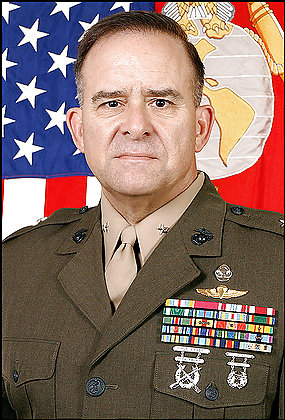
In amerikanischen Gefängnissen im Irak gibt es ein Programm zur geistigen Rehabilitation von Dschihadisten. Die Armee bedient sich moderater Muslime, um die radikalisierten Jungen vom Al-Kaida-Islam abzubringen. Gefangene werden in einer Anstalt namens “Haus der Weisheit” gehalten, wo die dschihadistische Theologie von gemäßigten Gelehrten zerpflückt wird. Für die “religiöse Aufklärung” ist der amerikanische General Douglas Stone verantwortlich, der die irakischen Haftanstalten der US-Armee befehligt.
Stone spricht arabisch und sagt von sich, er lese täglich im Koran.

stone.jpg
Marine-General Douglas Stone Foto: US Marine Corps

Stone said such efforts, aimed mainly at Iraqis who have been held for more than a year, are intended to “bend them back to our will” and are part of waging war in what he called “the battlefield of the mind.” Most of the younger detainees are held in a facility that the military calls the “House of Wisdom.”

The religious courses are led by Muslim clerics who “teach out of a moderate doctrine,” Stone said, according to the transcript of a conference call he held from Baghdad with a group of defense bloggers. Such schooling “tears apart” the arguments of al-Qaeda, such as “Let’s kill innocents,” and helps to “bring some of the edge off” the detainees, he said.

Die ganze Geschichte in der Washington Post

Saudischer Journalist: Bin Laden soll über seine eigenen Verbrechen Rechenschaft geben

Von 14. September 2007 um 10:59 Uhr

Der Meinungsredakteur der arabischen Tageszeitung Asharq Alawsat lässt seine Wut über Bin Ladens neue Rede und über die klammheimlichen Unterstützer des Terrorpropheten freien Lauf. Bin Laden hat die Amerikaner in seiner Rede des Massenmordes im Irak angeklagt. Mshari Al-Zaydi kontert:

We want the leader of Al Qaeda and his supporters – and there are many varying between secret admirers to declared admirers and fans and those who only half-declare their support – we ask of him and them to speak about Al Qaeda’s crimes in Iraq and how they have contributed to the death and destruction!

mashari.gif

Mshari Al-Zaydi
Foto: Asharq Alawsat

Here are a few questions for you Mr. Osama Bin Laden: Has Al Qaeda contributed to the rise of murders and has it endorsed death and destruction in Iraq? Have its bombs, explosive devices planted in cars and suicide bombers played a part in increasing the death toll in Iraq? Have victims not fallen in Iraq as a result of your followers strapping themselves up with explosives belts and detonating them to kill innocent people?

You are not in a position to preach or speak or play the hero in the story of murder in Iraq. We sincerely would like to believe your grief and compassion for the dead in Iraq, but the daily realities prevent us from doing so.

Whoever believes that the threat posed by Osama, Al Qaeda and fundamentalism (with all the danger entailed in terms of ideology) has subsided or diminished in any way is deluded, if I may say so.

All that has happened since the September 11 attacks in 2001 was a case of bowing down in the face of the American storm, while disregarding the internal criticism among the Arab and Muslim communities until things ‘pass’. Since then, no changes and nothing new has been proposed and no one cares.

Even the ‘streetwise’ singer Shaaban Abdel Rahim thinks Osama Bin Laden is right and regards him as a hero. He sings:

I commend Bin Laden for the tower he bombed

We want another attack to make the Arabs happy.

This is what Shaaban hopes for, on behalf of the Arabs, a second strike to make them happy. Perhaps that is what Bin Laden is planning for with his new youthful image, to bring everyone back to their youth!

Syrien als Zuflucht?

Von 10. September 2007 um 22:03 Uhr

Syrien ist eines der Länder, die von den USA als Schurkenstaaten – Unterstützer des internationalen Terrorismus, Feinde der liberalen Demokratie – betrachtet werden. Was sagt es über das Ausmaß des Desasters im Irak, dass täglich 2000 Iraker aus dem vermeintlich “befreiten” Land in die totalitäre Herrschaft des Assad-Regimes fliehen?

Dies sagt Erika Feller vom UN-Flüchtlingskomissariat gegenüber Asharq-Alawsat:

“Approximately 2,000 Iraqis cross the border into Syria every day in search of a safe haven. So far, more than two million Iraqis have left Iraq and I think Iraqis will continue to leave because of the hard circumstances, turmoil, violence and religious persecution. I do not think anyone living in such circumstances can stay in Iraq. I was in Syria and saw the enormous numbers of Iraqis who have left Iraq. The number of Iraqis in Jordan and Lebanon may have stabilized, but not in Syria. It is difficult to determine the figures because we do no know where these Iraqis are staying.”

Kategorien: Außenpolitik, Irak

Arabischer Intellektueller: Irakische Elite ist schlimmer für das Land als die Besatzung

Von 29. August 2007 um 13:41 Uhr

Der kluge und unabhängige Kopf Hazem Saghieh greift in Al-Hayat die Regierung Al-Maliki an: Die Besatzung mag an vielem Schuld sein, doch sie hat dem Land doch immerhin die beispiellose Möglichkeit gegeben, eine freie politische Szene zu entwickeln, sowie ein Parlament zu installieren und eine Verfassung zu verabschieden.

Even if the occupation bears its share of responsibility, the political elite of Iraq bears more blame. Despite all the evils attributed to it, the occupation did after all manage to offer Iraq an unprecedented opportunity to develop a free political scene and to create both a parliament and a constitution. Something, however, seems to have gone very wrong as the current situation reveals.

The structure of the present Iraqi elite tells many tales. It is a replacement of the Baathist elite, ironically both opposite and similar to it. It did not only emerge out of religious and sectarian parties, Sunni or Shiite alike, but it also sprang out of radical experiences that never had any constitutional awareness or democratic culture. It is equally relevant that some of the prominent members of the Iraqi elite have gotten where they are today after passing through a variety of Maoist and leftist parties with a history of despising politics and its petty bourgeoisie games. Parallel to this path, they seem to have developed admiration for religious tyrannies such as the Iranian regime, or military tyrannies such as the regime in Syria.

The political leaders of Iraq are devastating their country beyond recognition and can deserve no respect for that no matter what their ethnic, religious or sectarian identities are. In that, they are no better than the Lebanese and other Arab elites that are pushing their nations to an unfortunate end.

sagieh.jpg

Hazem Saghieh, Meinungsredakteur der panarabischen Tageszeitung Al-Hayat

Kategorien: Außenpolitik, Irak

Zur Debatte um die Wende im Irak: 600 Leichen in Bagdad in einem Monat

Von 10. August 2007 um 12:17 Uhr

Wende im Irak? Nach einem moderat positiven Spiegel-Titel über die Lage im Land wird auch bei uns debattiert, ob es im Irak gar nicht so desaströs aussieht, wie es in den letzten Jahren schien.
Hier Material zu der beginnenden Debatte, ob das Desaster noch abgewendet werden kann.
In nur einem Monat – zwischen dem 18. Juni und dem 18. Juli 2007 wurden in Bagdad mindestens 592 oftmals verstümmelte Leichen gefunden – Opfer schiitischer und sunnitischer Todesschwadrone. Hier die anschauliche Statistik des Grauens:
baghdad-unidentified+bodies31.jpg

Klick hier.

Kategorien: Debatte, Irak

Irakkriegsbefürworter Ignatieff: Wie konnte ich so daneben liegen?

Von 6. August 2007 um 14:38 Uhr

Michael Ignatieff, der kanadische Historiker, Essayist und (neuerdings) Politiker, geht angesichts des Desasters in Irak in sich und fragt sich in einem traurigen und schönen Text, wie er – als Kriegsbefürworter – so schief liegen konnte. Der ganze Text im New York Times Magazine:

“We might test judgment by asking, on the issue of Iraq, who best anticipated how events turned out. But many of those who correctly anticipated catastrophe did so not by exercising judgment but by indulging in ideology. They opposed the invasion because they believed the president was only after the oil or because they believed America is always and in every situation wrong.

mi_nom_1.jpg

Der Intellektuelle im Wahlkampf: Ignatieff in Ontario Foto: Ignatieff Campaign

The people who truly showed good judgment on Iraq predicted the consequences that actually ensued but also rightly evaluated the motives that led to the action. They did not necessarily possess more knowledge than the rest of us. They labored, as everyone did, with the same faulty intelligence and lack of knowledge of Iraq’s fissured sectarian history. What they didn’t do was take wishes for reality. They didn’t suppose, as President Bush did, that because they believed in the integrity of their own motives everyone else in the region would believe in it, too. They didn’t suppose that a free state could arise on the foundations of 35 years of police terror. They didn’t suppose that America had the power to shape political outcomes in a faraway country of which most Americans knew little. They didn’t believe that because America defended human rights and freedom in Bosnia and Kosovo it had to be doing so in Iraq. They avoided all these mistakes.

I made some of these mistakes and then a few of my own. (…)”

p.s.: In eigener Sache: Ignatieff sagt in seinem Text auch, er werde nicht mehr den Fehler machen, sich von verfolgten Menschen, mit denen er sympathisiert, agitieren zu lassen. Das bezieht sich auf die irakische Opposition im Exil, die für den Sturz Saddams geworben hatte.
Auch ich habe mich von den Argumenten der Exilanten beeindrucken lassen. Ich habe vor dem Krieg ein grosses Interview mit Kanan Makiya geführt, dem Autor von “Republic of Fear” dessen Engagement mich sehr für die Sache der Demokratisierung des Irak eingenommen hat. Mein Interview mit ihm ist hier nachzulesen. Zum Glück ist meinen skeptischen Fragen nicht anzusehen, wie sehr auch ich damals schief gelegen habe mit meinen Hoffnungen, für die andere den Preis bezahlen.

Kategorien: Außenpolitik, Debatte, Irak

Das Ende des Interventionismus

Von 31. Juli 2007 um 15:25 Uhr

Ich fürchte, John Gray (Professor an der London School of Economics) hat recht, wenn er die geplanten amerikanischen Waffenverkäufe an die “moderaten” arabischen Regime so kommentiert:

The era of liberal interventionism in international affairs is over.

Die USA haben die Demokratisierung des Nahen Ostens aufgegeben und kehren zu eben jenem “Realismus” zurück, den sie zuvor für überholt erklärt haben.

j.gray.jpg
John Gray Foto: LSE

Gray begrüßt dies ausdrücklich und zieht eine Schreckensbilanz des Irak-Abenteuers:
Der Staat Irak ist Geschichte, was nur noch im Weissen Haus und der Phantasiewelt der Grünen Zone Bagdads geleugnet werde.
Die USA können aus dem Irak nicht einfach verschwinden wie aus Vietnam, weil Irak nicht an der Peripherie der Weltökonomie liegt und weil es keine funktionierende Regierung wie seinerzeit in Nordvietnam gibt, die übernehmen könnte. Sie bleiben gebunden in den Krieg um die Ressourcen und um die damit verbundene strategische Bedeutung des Landes und seiner Nachbarn.
Dies hier ist der finsterste Teil seiner Bilanz:

“The most important – as well as most often neglected – feature of the conflict shaping up around Iraq is that the US no longer has the ability to mould events. Whatever it does, there will be decades of bloodshed in the region. Another large blunder – such as bombing Iran, as Dick Cheney seems to want, or launching military operations against Pakistan, as some in Washington appear to propose – would make matters even worse.

The chaos that has engulfed Iraq is only the start of a longer and larger upheaval, but it would be useful if we learned a few lessons from it. There is a stupefying cliche which says regime change went wrong because there was not enough thought about what to do after the invasion. The truth is that if there had been sufficient forethought the invasion would not have been launched. After the overthrow of Saddam – a secular despot in a European tradition that includes Lenin and Stalin – there was never any prospect of imposing a western type of government. Grotesque errors were made such as the disbanding of the Iraqi army, but they only accelerated a process of fragmentation that would have happened anyway. Forcible democratisation undid not only the regime but also the state.

Liberal interventionists who supported regime change as part of a global crusade for human rights overlooked the fact that the result of toppling tyranny in divided countries is usually civil war and ethnic cleansing. Equally they failed to perceive the rapidly dwindling leverage on events of the western powers that led the crusade. If anyone stands to gain long term it is Russia and China, which have stood patiently aside and now watch the upheaval with quiet satisfaction. Neoconservatives spurned stability in international relations and preached the virtues of creative destruction. Liberal internationalists declared history had entered a new stage in which pre-emptive war would be used to construct a new world order where democracy and peace thrived. The result of these delusions is what we see today: a world of rising authoritarian regimes and collapsed states no one knows how to govern.”

Kategorien: Außenpolitik, Irak