Energiewende and its impact on Germany´s labour market
Germany is undergoing the Energiewende, a milestone project in transfering the energy and transport sector from nuclear power and fossil energies to renewables and energy efficiency. I found an impressive chart from the Heinrich-Böll-Foundation, an institution close to Germany´s Green Party. On energytransition.de they compared numbers from the Ministry of Environment und from the Ministry of Economics concerning the job growth in the old and new energy sectors. Result: Renewables are the main job driver.
(In eigener Sache: Vielleicht wundert sich der ein oder andere Leser, dass ich diesmal auf Englisch gebloggt habe. Aber das Thema “Energiewende” wird besonders auch vom Ausland mit Interesse verfolgt: Wie bekommt eine Industrienation wie Deutschland die Wende hin. “Energiewende” ist inzwischen ja selbst im englischsprachigen Raum ein feststehender Begriff, so wie “Kindergarten”. Und daher hier einmal ein Experiment, auch die englischsprachigen Leser mit Informationen zu versorgen.)
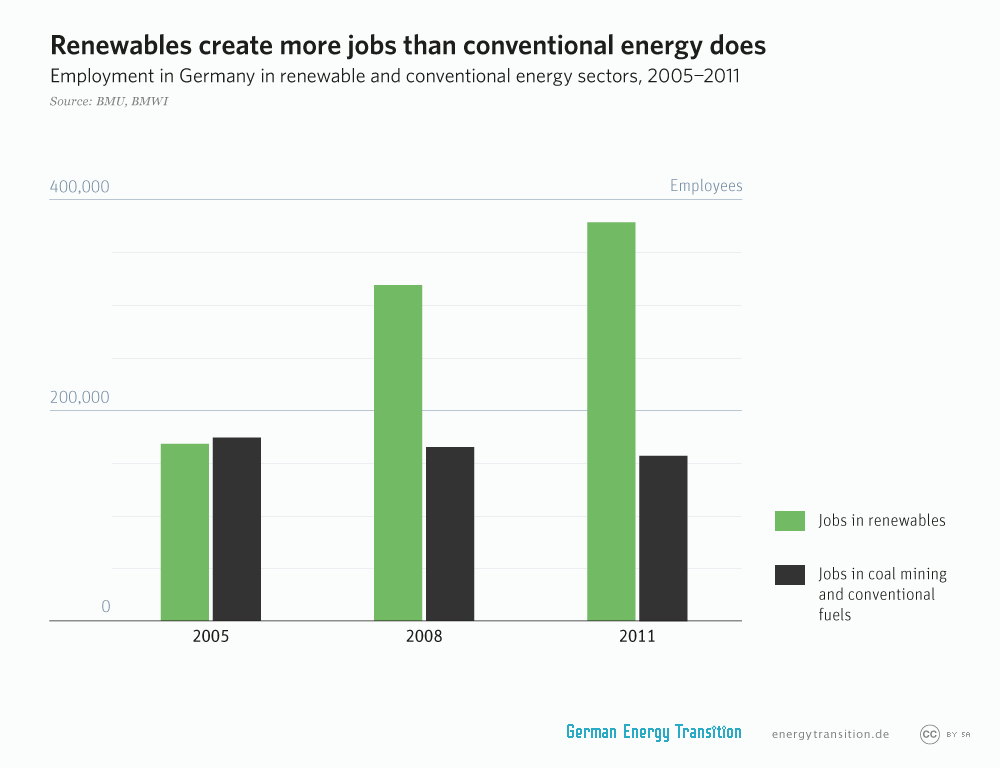
der chart ist wirklich “impressive”!
er zeig nämlich wie ineffizient die eneneuerbaren energien sind.
um eine kWh zu erzeugen müssen nämlich viel mehr menschen arbeiten (und vom verbraucher bezahlt werden).
wenn sie das so toll finden, dann sollten sie das auch konsequent weiterdenken:
wir setzen die menschen auf standfahräder mit dynamo. das perfekte bürger-energie-projekt: arbeitsplätze in hülle und fülle, regional erzeugt und die leidigen probleme mit wolken, nacht und flaute wären auch gelösst
Tja, die grünen Balken Ihrer kopierten Grafik über Jobs in der Industrie der “NIE”- oder Flackerenergieerzeugung können nur so hoch sein, weil alle diese mit dem vom Untennachobenverteilungsprogramm der ökosozialistischen Parteien Deutschland subventioniert werden.
Das sind Subentionen in Uralttechnik und das Geschrei ist riesig, wenn die Greenjobs wieder flöten gehen, wenn sich dieser ganze Betrug am Markt behaupten soll – oder die Chinesen dazwischenfunken.
Sie haben aber recht, ist Deutschland deindustrialisiert duch die Ökosozialisten, dann wächsen die grünen Balken Ihrer potjemkinschen Dörfer in den Himmel.
Ansonsten Frau Uken, vielleicht versuchen Sie es mal mit Chinesisch oder Arabisch. Letztere können noch viel von Ihnen lernen.
Vielen Dank fur die englische Version. Energiewende wird tatsachlich auch aus Ausland intensiv verfolgt!
SUbventioniert wird in Deutschland die stromintensive Industrie (durch die sog. Besondere Ausgleichsregelung). Diese Tatsache wurde gerade im letzten Jahr massiv ausgebaut. Neben den erweiterten Privileg einer geringeren EEG-Umlage brauchen Großverbraucher auch weniger Netzentgelte zu zahlen. Stattdessen werden die Kosten auf alle anderen Stromverbraucher verteilt. Dazu kam noch Ende letzten Jahres die Offshore-Haftungsumlage.. und die EEG-Umlage wurde unnötig aufgebläht mit einer Marktprämie und einer höheren Liquiditätsreserve.. das mindeste was die Regierung machen sollte, ist die Besondere Ausgleichsregelung wieder auf den Stand von 2009 zurückzufahren.. Mehr Infos bei der Petition: https://www.openpetition.de/petition/online/streichung-der-erweiterung-der-besonderen-ausgleichsregelung-fuer-stromintensive-unternehmen
Thanks Marlies!
You´re welcome. Where are you located?
Best
Marlies
gefunden und von mir unkommentiert:
Carey and Wolfe VaUeYeJpposition to wind turbines
I am James Lovelock, scientist and author, known as the originator of Gaia theory, a view of the Earth that sees it as
a self-regulating entity that keeps the surface environment always fit for life.
When I was a schoolboy in the 1930s I cycled from my home in Kent to Land’s End and back. England then
enjoyed a countryside that was seemly and probably the most beautiful anywhere; every mile of my joumey was
along quiet lanes in fresh air unperturbed by traffic. I passed through an ever changing landscape that reflected in its
vegetation a diverse geology going from the recent rocks of Kent back almost to the Precambrian in Cornwall. Our
land had evolved by chance to become a place where humans lived in peaceful coexistence with the natural world
and so became a part of it. In that humane ecology animals and plants benefited from our presence as we did from
theirs. Blake’s dark satanic mills existed but within densely populated cities that occupied only a small part of the
whole and, from those cities, untouched countryside was no more than a tram journey away. Sadly, that splendid
countryside has all but vanished; replacing it is an agribusiness, factory farming that is more efficient at producing
food but dull to look at and ecologically poor. At the same time, better cars and roads have enabled a vast expansion
of suburbia and of second homes. England is becoming one large town haphazardly interspersed with ‘Greenfield
sites’. The few sizeable stretches of original countryside that remain are in rural North and West Devon and
Northumberland and here people and wild life still coexist in a more or less seemly and sustainable fashion; these
are places where woodland and hedgerows still serve both humans and wild life. This remaining English countryside
is much more than an aesthetic asset, Earth scientists now recognise our planet to be a self-regulating system that
sustains habitability for its inhabitants and for this function we need the natural forests and life in the coastal and
deep ocean waters to interact with the air and ocean and so keep a constant and habitable environment. Ideally,
humans should live in coexistence with the other forms oflife so that our presence is benign; but in most of the
world this rarely happens. We need to treasure the few exceptions such as the North Devon countryside so that they
can be an example of how humans can live sustainably with the Earth. A whole library of books going from Gilbert
White’s Natural History ofSelbourne to the New Naturalist series of the 1960s, testifies to the richness, health and
beauty of England as it once was. We are fortunate indeed that some of it remains in North West Devon and we
must look upon it as our most precious assets.
It is true that we need a better way of producing energy and there is little doubt among scientists, and I speak as one
of them, that the buming of fossil fuels is by far the most dangerous source of energy. By using it to power industry,
our homes and transport, we are changing the composition of the air in a way that will have profoundly adverse
effects on the Earth’s ecology and on ourselves
Anything we do in the United Kingdom about energy sources is mainly to set a good example before the other
nations; if we drew all of our energy from renewable sources it would make only a small change in the total
emission of greenhouse gas. But such examples are needed and are something to be proud of. The benign way we
in North Devon live with our countryside is also an example to set before the world about how to live sustainably
12/12/2012
Page 2 of2
with the Earth. How foolish to set two such noble ideas in conflict and arrange that one good intention destroyed the
other. To erect a large wind turbine on the Broadbury Ridge above the Carey and Wolfe Valleys is industrial
vandalism that will diminish the regard with which the countryside is held and make the region vulnerable to urban
development and unsustainable farming. Even if there were no alternative source of energy to wind we would still
ask that this 84 metre high industrial power plant was placed in less ecologically sensitive areas. Better still we
should look to the French who have wisely chosen nuclear energy as their principal source; a single nuclear power
station provides as much as 3200 large wind turbines.
I am an environmentalist and founder member ofthe Greens but I bow my head in shame at the thought that our
original good intentions should have been so misunderstood and misapplied. We never intended a fundamentalist
Green movement that rejected all energy sources other than renewable, nor did we expect the Greens to cast aside
our priceless ecological heritage because of their failure to understand that the needs of the Earth are not separable
from human needs. We need take care that the spinning windmills do not become like the statues on Easter Island,
monuments of a failed civilisation.
James Lovelock